USGS - science for a changing world
IPY logo

International Polar Year 2007-2008

IPY Home /  What is IPY? /  USGS & IPY /  News, Updates & Background /  Links /  Contacts
collage of polar related images

USGS Educational Resources

Alaska and the Arctic | Antarctica | Climate Change | Glaciers and Ice | Photographs | Satellite Imagery | Wildlife | See entire resources index


Click topic headings for more information.

Other USGS Resources

ASK USGS

What is it?What Can I Do With It?What Does It Look Like?
The USGS is more than scientific studies—it´s also people. USGS information specialists in our Natural Science Information Network USGS scientists can help you with your data needs.

Get personalized, expert service.

Discover how to access and use USGS resources: people, maps, web sites, databases, photographs, satellite imagery, digital maps, books, reports, research, and more. Learn more…

Ask USGS

Global GIS

What is it?What Can I Do With It?What Does It Look Like?

The USGS Global GIS database, created in partnership between the USGS and the American Geological Institute contains a wealth of USGS and other public domain data, including global map layers of elevation, land cover, seismicity, and resources of minerals and energy.

Use the data, tools, and lessons to make maps and examine spatial patterns of land cover, elevation, geology, eco–regions, population, seismicity, energy, and minerals in an interactive way within an inquiry–based GIS environment. The GIS runs on the included ArcView Data Publisher software and is available on seven CD–ROMs or one DVD–ROM. Learn more…

Global GIS

National Atlas of the United States

What is it?What Can I Do With It?What Does It Look Like?

The National Atlas is a Web site where over 200 map layers from over a dozen different agencies. One of the premier sites for national map data.

Make and print online maps, download layers to a geographic information system, and obtain statistics for a wealth of variables in Alaska and the rest of the United States. Topics include land use, invasive species, landforms, aquifers, watersheds, and more. Learn more…

National Atlas of the United States

Real-Time and Historical Earthquake Data

What is it?What Can I Do With It?What Does It Look Like?

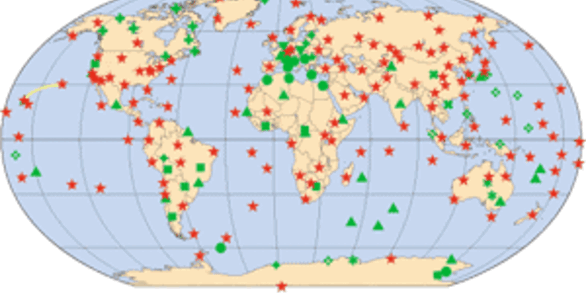
This information details earthquakes from today to years in the past and is customizable for the polar regions and other parameters of time, depth, or magnitude.

Use these sites to compare polar earthquakes to those elsewhere in the world:

Real–Time and Historical Earthquake Data

The National Map

What is it?What Can I Do With It?What Does It Look Like?

The National Map is a wealth of dynamic map layers for the United States, including aerial photography, elevation, land use, energy assessments, hydrography, and much more.

Use this resource to make and print hundreds of online maps and download spatial data to a geographic information system for Alaska and the rest of the United States. Learn more…

The National Map

USGS Library

What is it?What Can I Do With It?What Does It Look Like?
Established in 1879 to build and organize a collection of scientific materials in the earth sciences, the USGS Library is now the largest library for earth sciences in the world. The library holds over one million books and journals, 450,000 maps, 370,000 microforms, 270,000 pamphlets, 250,000 black–and–white photographs, 50,000 color transparencies, and 15,000 field–record notebooks, among other items.

Browse the USGS Library online or at a USGS facility, or obtain many USGS publications on interlibrary loan. Use the library to research thousands of USGS publications and studies concerning polar environments. Library holdings include USGS publications as well as those produced by State and foreign geological surveys, scientific societies, museums, academic institutions, and government scientific agencies. Learn more…

The USGS Library

Geodetic Control

What is it?What Can I Do With It?What Does It Look Like?

This is a historical archive of geodetic surveys, maintained by the U.S. Antarctic Resource Center. These ground control locations and field records were needed to produce topographic maps, for planning, and for reconnaissance.

Use this site to examine historical aerial photographs to understand the physical features of Antarctica. You can also compare the historical photographs to newer imagery to detect change over time. Learn more…

Geodetic Control

Geographic Names Information System

What is it?What Can I Do With It?What Does It Look Like?

The GNIS, developed by the USGS in cooperation with the U.S. Board on Geographic Names , contains information for all geographic features in Antarctica. The database contains the name of the feature and its latitude–longitude coordinates.

Use the GNIS to look up names of features and places in Antarctica and locate them. Learn more… Geographic Names Information System

Mineral Resource Data System

What is it?What Can I Do With It?What Does It Look Like?

This system contains records of metallic and nonmetallic mineral resources of the world. Records contain descriptive information about mineral deposits and mineral commodities, including deposit name, location, commodity, deposit description, geologic characteristics, production, reserves, potential resources, and references.

Use this database to examine minerals, geology, gravity, magnetism, and other characteristics of the polar regions. Learn more…

Mineral Resource Data System

Mineral Resources Online Spatial Data

What is it?What Can I Do With It?What Does It Look Like?

This is a source for regional and global geology, geochemistry, geophysics, and mineral resource maps and data that includes a map browser for the United States and the world.

Use this site´s interactive maps to explore mineral resources in the polar regions. Learn more…

Mineral Resources Online Spatial Data

Real-Time Water Data

What is it?What Can I Do With It?What Does It Look Like?

The network of thousands of USGS gaging stations in Alaska and elsewhere in the United States offers real–time and historic streamflow, water quality, groundwater, lake levels, and other hydrologic information in graph and tabular form.

How much water flowed through different streams 5 minutes ago? What was the flow for the last 7 days? What were the historic maximums for certain rivers? What is the level of lakes? What is the water quality like? Find the answers to these and other questions via this database. Learn more…

Real–Time Water Data

Shuttle Radar Topography Mission (SRTM) Elevation Data

What is it?What Can I Do With It?What Does It Look Like?

These are digital elevation data of the Earth´s surface, including the polar regions, at 90–meter spatial resolution, from which shaded relief, slope maps, contours, direction of slope, and more can be derived.

Examine the elevation and topography of the polar regions with this global dataset. Learn more…

Shuttle Radar Topography Mission (SRTM) Elevation Data

Global Change

What is it?What Can I Do With It?What Does It Look Like?

This teacher´s guide is focused on how the Earth is constantly changing. Weather and seasons are clear examples of regular changes in the global environment. Other changes are not as evident because they occur over intervals longer than a human lifetime or are not easily seen. Much of the change takes place on Earth is part of natural cycles. Human activity, however, can also cause environmental changes.

Use activities on greenhouse gases, tree ring dating, and more to help teach concepts of global change. The Teacher's Guide explains how the activities are related to time, change, cycles, and Earth as home. Learn more…

Global Change

to top


USGS International Home / 

Accessibility FOIA Privacy Policies and Notices

Take Pride in America logo USA.gov logo U.S. Department of the Interior | U.S. Geological Survey
URL: http://international.usgs.gov/ipy/resources/other.shtml
Page Contact Information: IPY Web Team
Page Last Modified: Friday, 09-Mar-2007 10:52:54 EST